
First-Time Home Buyers
What to Look for When Touring a House
When touring a house, look past the finishes and evaluate the entire property: its overall condition, visible moisture clues, major systems, windows, basement, layout, storage, parking, location and any renovations that may need more research.
By Tom FiorPublished Updated 9 min read
Last reviewed:
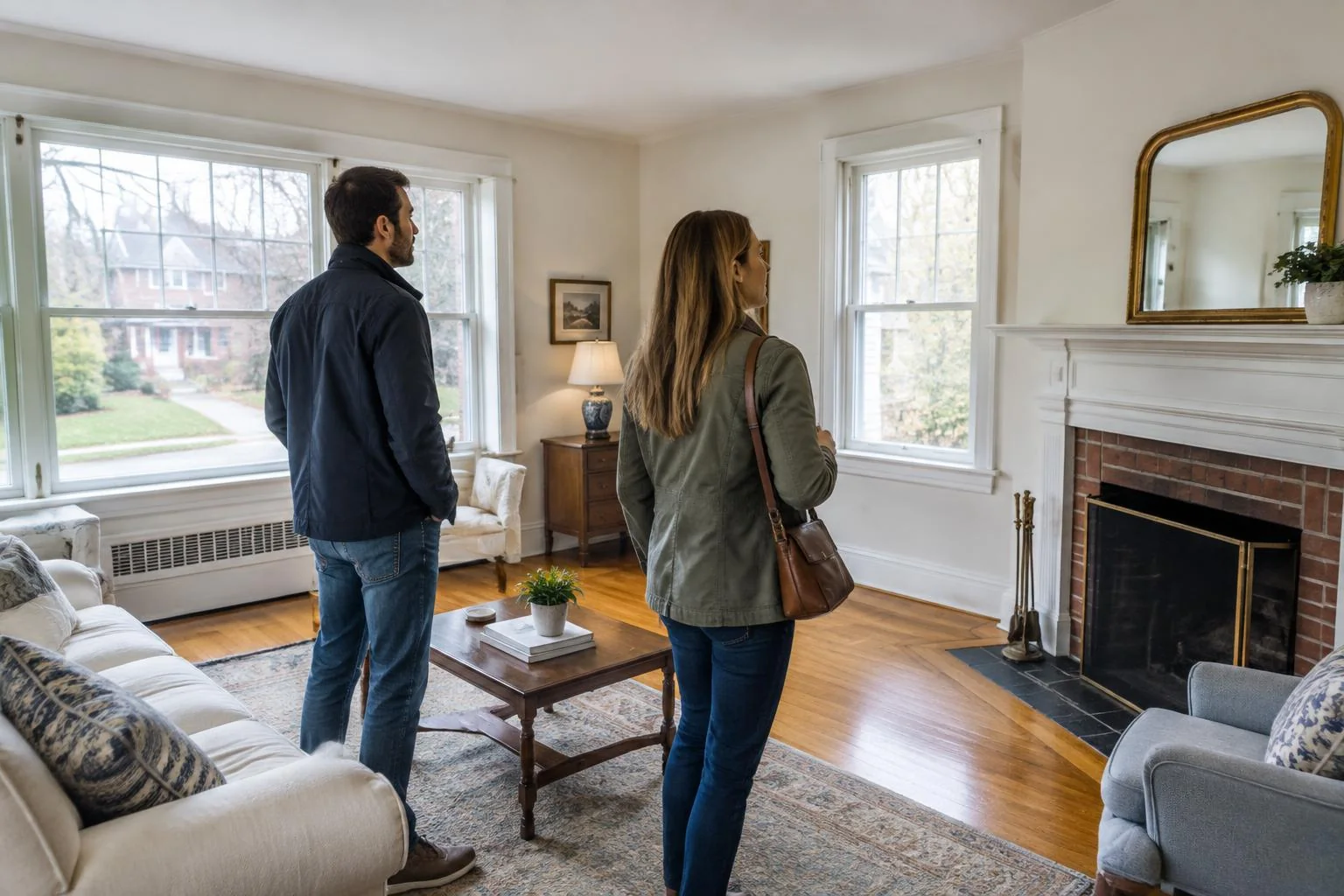
You are not trying to perform a home inspection during a showing. You are deciding whether the house works for your life, whether its condition fits your comfort level and which questions need answers before you consider an offer.
A pretty kitchen can absolutely matter. You are allowed to like nice countertops. Just do not let them distract you from the rest of the house.
Start Looking Before You Walk Through the Front Door
The tour starts outside.
Pause long enough to notice the property and the block instead of heading straight for the kitchen. Look at the visible condition of the roof, siding, masonry, porches, steps, gutters, walkways and yard.
You are not diagnosing defects. You are looking for anything that deserves a question or a closer look by the appropriate professional.
Also pay attention to the parts of the location that affect normal life:
- Where would you park?
- Is the street busier or quieter than you expected?
- How difficult is it to enter or leave the property?
- Where are the trash cans, outdoor equipment and storage items kept?
- How close are neighboring homes, intersections, businesses or other features that matter to you?
Listing photos are very good at showing the house and very bad at showing what Tuesday at 6:00 p.m. feels like.
If parking, traffic or noise could affect your decision, return at another time and experience the area for yourself.
Look at the House as a Whole
One cracked tile does not automatically make a house a problem. One renovated room does not automatically make it well maintained either.
Look for the overall pattern.
Does the home appear cared for? Do repairs look thoughtful or temporary? Are several areas worn, damaged or unfinished? Does the condition seem consistent throughout the house, or does one updated room stand out from everything around it?
This helps you separate cosmetic work from the broader condition of the property.
Paint is easy to notice. Deferred maintenance is usually less interested in getting your attention.
Ask What Is Known About the Major Systems
You may not be able to determine the condition of a roof, heating system or electrical panel during a showing. You can still collect useful information.
Ask whether the age, service history or replacement date is known for:
- The roof
- Heating and cooling equipment
- Water heater
- Electrical service and panel
- Plumbing or sewer work
- Major appliances included with the sale
An answer such as “newer” is not the same as a date, invoice, permit or service record.
When documentation is available, review it. When the answer is unknown, keep it in the question column instead of turning it into an assumption.
Age alone does not tell you whether a system is good or bad. It tells you what may deserve more attention during due diligence.
Pay Attention to Water and Moisture Clues
Water can leave clues even when everything is dry during your showing.
Notice visible staining on ceilings, walls or basement surfaces. Pay attention to musty odors, peeling paint, damaged trim, recently patched areas, dehumidifiers or sump pumps.
Outside, notice whether gutters and downspouts are present and where water appears to be directed.
None of these details proves that there is an active problem. A stain may be old and repaired. A sump pump may be a sensible precaution. Fresh paint may simply be fresh paint.
The point is not to diagnose the cause. The point is to ask what happened, what was done and whether the issue should be evaluated further.
Check the Windows Without Pretending You Are the Inspector
Windows affect comfort, maintenance and how a room feels.
Look for visible damage, fogging between panes, deteriorated frames or windows that appear painted shut.
If the seller permits it, try opening a representative window or two instead of testing every window in the house.
Then step back and ask a simpler question: Does the home have the natural light, privacy and ventilation you expected?
Do Not Rush Through the Basement
First-time buyers often spend twelve minutes in the kitchen and twelve seconds in the basement. Flip that ratio at least a little.
The basement can show you parts of the home that are hidden elsewhere. Notice its general condition, smell, visible moisture clues, foundation surfaces, access to mechanical equipment, ceiling height and usable storage.
If the basement is finished, look at the quality and completeness of the work. Ask when it was completed and whether permits or other documentation are available when applicable.
Again, this is observation, not inspection. Large cracks, movement, moisture or other concerns should be evaluated by a qualified professional rather than diagnosed during the showing.
Test the Layout Against Your Actual Life
A house can have the right bedroom count and still have the wrong layout.
Walk through it as if you already live there:
- Where do coats, shoes, a vacuum and normal clutter go?
- Will your furniture fit without blocking the room?
- Does the kitchen have enough practical storage and workspace?
- Is the trip from the bedrooms to the bathroom reasonable?
- Are laundry and stairs going to become annoying?
- Is there space for the way you work, host, relax or store things?
- Can you live with the bedroom sizes after the wide-angle listing photos are gone?
Room count gets you through the search filter. Layout determines whether the house works on an ordinary day.
Treat Parking as Part of the Property
Parking is not a footnote, especially when comparing Philadelphia with communities in Delaware County.
Confirm what actually belongs to the property. A driveway shown in a photo may be shared. A space behind the house may require alley access. Street parking that looks easy at noon may feel very different after work.
Ask about garages, private driveways, shared access, permits or association rules when any of those apply.
Then verify the details that matter instead of relying on an assumption made during a quiet showing.
Ask Better Questions About Renovations
New flooring and a remodeled bathroom tell you what changed visually. They do not tell you how the work was completed.
For meaningful renovations, ask:
- What work was done?
- When was it completed?
- Who completed it?
- Were permits required and obtained?
- Are invoices, warranties or other records available?
Permit requirements and records can vary by municipality.
Delaware County contains 49 municipalities, so the correct place to verify local permit information is generally the township, borough or city responsible for that specific property—not simply the mailing address.
Lack of an immediate answer does not automatically mean something is wrong. It means more information may be needed before you rely on the renovation as a selling point.
What This Looks Like in Delaware County
Touring homes in Havertown, Drexel Hill, Springfield, Ridley, Media and nearby communities can put very different types and ages of housing on the same search screen.
You may move from a twin to a Cape Cod, split-level, rowhome or detached property in the same afternoon.
Different homes reveal different tradeoffs: basement condition, parking, additions, window age, storage, room size and renovations completed by different owners over time.
That does not make an older home a bad choice or a newly renovated home a good one. It means the property should be evaluated on its own facts.
The municipality matters too.
In Delaware County, local permit records, resale requirements and other property-specific questions may be handled municipality by municipality.
Your Realtor can help identify the right questions and the right local office or professional for the answer.
Smart Home-Tour Checklist
Use this short checklist at every showing:
Smart Home-Tour Checklist
Overall condition and maintenance pattern · Visible roof and exterior condition · Known ages of major systems · Water stains, musty odors or moisture clues · Window condition and natural light · Basement condition and storage · Layout and realistic furniture fit · Parking and property access · Street, traffic and surroundings · Renovation details and permit questions · Items to verify before an offer · Items for a professional inspector to evaluate
Do not try to remember everything while walking through five houses.
Take brief notes immediately after each tour, while the property is still clear in your head.
A Showing Is Not a Home Inspection
A showing is a short, non-invasive visit. A professional home inspection is a more detailed evaluation of the home’s accessible systems and components.
An appraisal is different again: It is primarily concerned with value for the lender and does not replace an inspection.
The Consumer Financial Protection Bureau and HUD both encourage buyers to understand the difference between an appraisal and a home inspection.
Your inspection choices, deadlines and rights depend on your agreement of sale and the specific transaction, so review them before signing an offer.
During a tour, your job is to notice, ask and record. If you move forward, the home inspector and any other qualified specialists handle the deeper evaluation.
What I Tell First-Time Buyers After Every Tour
Before discussing whether you “love” the house, answer four questions:
- Does the location and layout work for your normal life?
- Does the visible condition fit the amount of work you are willing to take on?
- What facts still need to be verified?
- Would you still want the house if the trendy finishes disappeared tomorrow?
That last question has ruined a few imaginary relationships with kitchen islands, but it is useful.
You do not need to find a flawless house. You need enough reliable information to decide whether this house’s tradeoffs make sense for you.
Frequently Asked Questions
What are the biggest warning signs to notice during a home tour?
Visible water staining, musty odors, significant cracking, unfinished repairs, damaged windows and unclear renovation work can all justify more questions.
They are clues, not diagnoses. A professional inspector or appropriate specialist should evaluate condition concerns.
Should I take photos and videos during a showing?
Ask for permission first.
If permitted, photograph details you will want to compare later, such as mechanical-system labels, visible staining, room layouts, parking access and renovation details.
Avoid photographing personal items that are unrelated to the property.
Should I visit a house more than once before making an offer?
When timing and seller access allow, a second visit can help you look past the first reaction.
In a faster-moving situation, review your notes, disclosures and unanswered questions with your Realtor before deciding whether to offer.
Can my Realtor tell me whether a roof, foundation or electrical system is okay?
A Realtor can help you notice concerns, gather available property information and organize the right questions.
The actual condition of the home should be evaluated by a qualified home inspector and, when needed, the appropriate specialist.
Is a home inspection still necessary if the house looks renovated?
A renovated appearance does not verify the condition of the structure or major systems.
Inspection decisions are yours and should be made with a clear understanding of the property, your agreement and the risk involved.
A showing is not a substitute for a professional inspection.
I’m Tom Fior, a Realtor with Coldwell Banker Realty and The Steven Eckell Team. I help first-time buyers across Philadelphia, Delaware County and the surrounding suburbs understand the homes they are considering without turning every showing into a sales pitch.
The house has to make sense after the excitement wears off.

About the author
Tom Fior | Philadelphia & Delaware County Realtor
Tom is a Realtor with Coldwell Banker Realty (The Steven Eckell Team) helping buyers, first-time buyers, sellers and move-up homeowners across Philadelphia, Delaware County and the surrounding suburbs. Guidance first. Pressure never.
Have questions about your move? Let's talk.